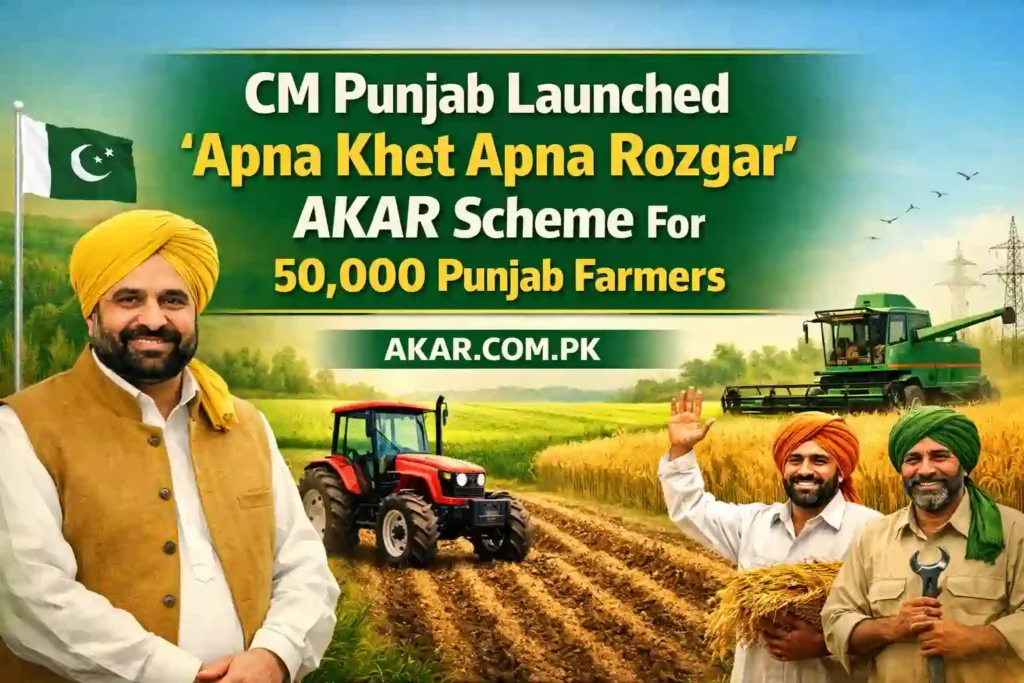
CM Punjab Launched ‘Apna Khet Apna Rozgar’ AKAR Scheme For 50,000 Punjab Farmers
The Punjab Government has introduced a major agricultural support initiative titled the Apna Khet Apna Rozgar (AKAR) Scheme 2026, targeting nearly 50,000 farmers across the province. The program is designed to enhance farming productivity, improve rural income opportunities, and strengthen the agricultural sector through modernization and structured support.
Agriculture continues to serve as the backbone of Punjab’s economy. However, small and medium-scale farmers face increasing pressure due to rising input costs, expensive machinery, and limited access to affordable financing. Without modernization, productivity growth may slow and profit margins may continue to shrink.
The AKAR Program Punjab has been launched to directly address these concerns by improving access to agricultural machinery, financial assistance, and farm development support. The initiative aims to make farming more efficient, profitable, and sustainable, particularly for farmers who cannot afford costly tractors, harvesters, and modern equipment on their own.
Why the AKAR Scheme Was Needed
Agriculture remains the backbone of Punjab’s economy, yet many farmers continue to face structural challenges. While land productivity remains strong, modernization has been slow because advanced agricultural machinery is expensive. Tractors, harvesters, seed drills, rotavators, and irrigation systems are often beyond the financial reach of small and medium farmers.
As a result, many farmers either rent machinery at high seasonal rates or depend heavily on manual labor. This increases production costs, reduces profit margins, and limits the ability to scale operations.
The Apna Khet Apna Rozgar Scheme 2026, also known as the AKAR Program Punjab, was introduced to address these modernization gaps. The program focuses on improving access to machinery and structured financial assistance so farmers can increase efficiency and long-term income.
Beyond mechanization, the initiative also aligns with broader rural employment goals by reducing migration toward cities and strengthening village-based economic activity.
Main Objectives of the AKAR Scheme
The CM Punjab AKAR Scheme 2026 has been designed around several core objectives.
Modernizing Agriculture
By encouraging the use of modern machinery, the scheme aims to improve efficiency in sowing, irrigation, cultivation, and harvesting.
Supporting Small and Medium Farmers
Farmers with limited capital often struggle to expand operations. The program offers structured assistance to help improve productivity and operational capacity.
Generating Rural Employment
Mechanization creates indirect employment in machinery operation, repair services, and agricultural support activities.
Increasing Farmer Income
Higher yields and lower production costs contribute directly to improved earnings and better financial stability for farming households.
Key Benefits Offered Under the Scheme
Participants in the Apna Khet Apna Rozgar initiative may benefit in several practical ways.
Easier Access to Agricultural Machinery
Farmers can obtain tractors and essential equipment through financing support or government-backed arrangements that reduce upfront investment.
Improved Farming Efficiency
Mechanization speeds up land preparation and crop management, helping reduce seasonal delays.
Reduced Dependence on Manual Labor
Modern tools allow farmers to manage larger areas effectively, lowering labor costs during peak farming periods.
Increased Crop Yield
Timely sowing and harvesting improve crop quality and overall market returns.
Income Opportunities for Rural Youth
Young individuals can start machinery rental services or agriculture-based support businesses, creating new employment streams.
Who Can Apply for the AKAR Scheme?
While final eligibility criteria are confirmed through official announcements, the program primarily targets:
- Small and medium-scale farmers
- Landowners requiring machinery assistance
- Individuals seeking to expand agricultural productivity
- Rural entrepreneurs interested in machinery-based services
Farmers across Punjab, especially those in rural and semi-rural districts, are expected to benefit under the structured rollout of the program.
Expected Machinery Support Under AKAR
The scheme is expected to facilitate access to:
- Tractors
- Seed drills
- Rotavators
- Ploughs and cultivators
- Harvesting equipment
- Land leveling machinery
- Sprayers and irrigation tools
Such equipment significantly enhances productivity while reducing operational inefficiencies.
Economic Impact on Punjab Agriculture
Modernization through structured mechanization programs can produce measurable economic impact.
Higher Productivity
Mechanized farming allows multiple crop cycles and efficient land utilization.
Lower Production Costs
Automation reduces dependency on expensive labor and improves time management.
Stronger Rural Economy
Increased agricultural output improves purchasing power within rural communities.
Job Creation
Machinery services, maintenance operations, and agricultural advisory roles generate employment.
Role of Government in Supporting Farmers
The Punjab Government has gradually shifted from traditional subsidy models toward modernization-focused programs. The AKAR Scheme reflects this approach by promoting mechanization instead of short-term financial relief.
Government intervention remains essential because private agricultural financing options are often costly and inaccessible to small farmers. Structured programs reduce financial barriers and improve long-term sustainability.
Challenges That Need Attention
Effective implementation requires addressing several key areas:
Awareness
Many eligible farmers may not receive timely information about registration phases.
Fair Distribution
Support must prioritize genuine farmers rather than intermediaries.
Training Support
Farmers require proper training to operate and maintain machinery efficiently.
Transparent Application System
A simple, digital application system improves accessibility and reduces confusion.
How Farmers Can Prepare
Farmers interested in applying can take proactive steps:
- Keep land ownership or tenancy documents ready
- Ensure CNIC and bank records are updated
- Monitor official agriculture department announcements
- Connect with district agriculture offices
- Consider forming cooperatives for shared machinery usage
Preparation improves readiness when the registration window opens.
Long-Term Impact of the AKAR Scheme
If implemented efficiently, the program can deliver long-term structural benefits.
Sustainable Agricultural Growth
Modern equipment allows adaptation to changing climate and crop demands.
Reduced Rural Poverty
Higher agricultural earnings improve village living standards.
Improved Food Security
Increased crop production strengthens provincial and national food stability.
Technology Adoption
Encouraging mechanization accelerates agricultural innovation.
Government’s Vision for Agricultural Modernization
Punjab’s broader vision includes transforming agriculture through technology adoption, financial inclusion, and productivity improvement. Programs such as the Apna Khet Apna Rozgar Scheme 2026 represent a strategic move toward modernization-driven development rather than temporary subsidy relief.
Investing in farmers today supports long-term economic stability and agricultural resilience.
What Farmers Are Expecting Next
Farmers are awaiting detailed information regarding:
- Online application procedures
- Financing and repayment terms
- Machinery allocation process
- Subsidy structure
- Registration deadlines and district quotas
Clear communication from authorities will ensure higher participation and smoother implementation.
Conclusion – CM Punjab Launched Apna Khet Apna Rozgar AKAR Scheme
The Apna Khet Apna Rozgar (AKAR) Scheme 2026 represents a major step toward modernizing Punjab’s agriculture sector. By improving access to machinery and structured financial support, the program aims to strengthen productivity, increase farmer income, and create rural employment.
If implemented transparently and efficiently, the initiative could significantly transform farming practices across the province. Farmers are hopeful that structured support, modernization, and accessible financing will help them overcome current challenges and build a more secure agricultural future.